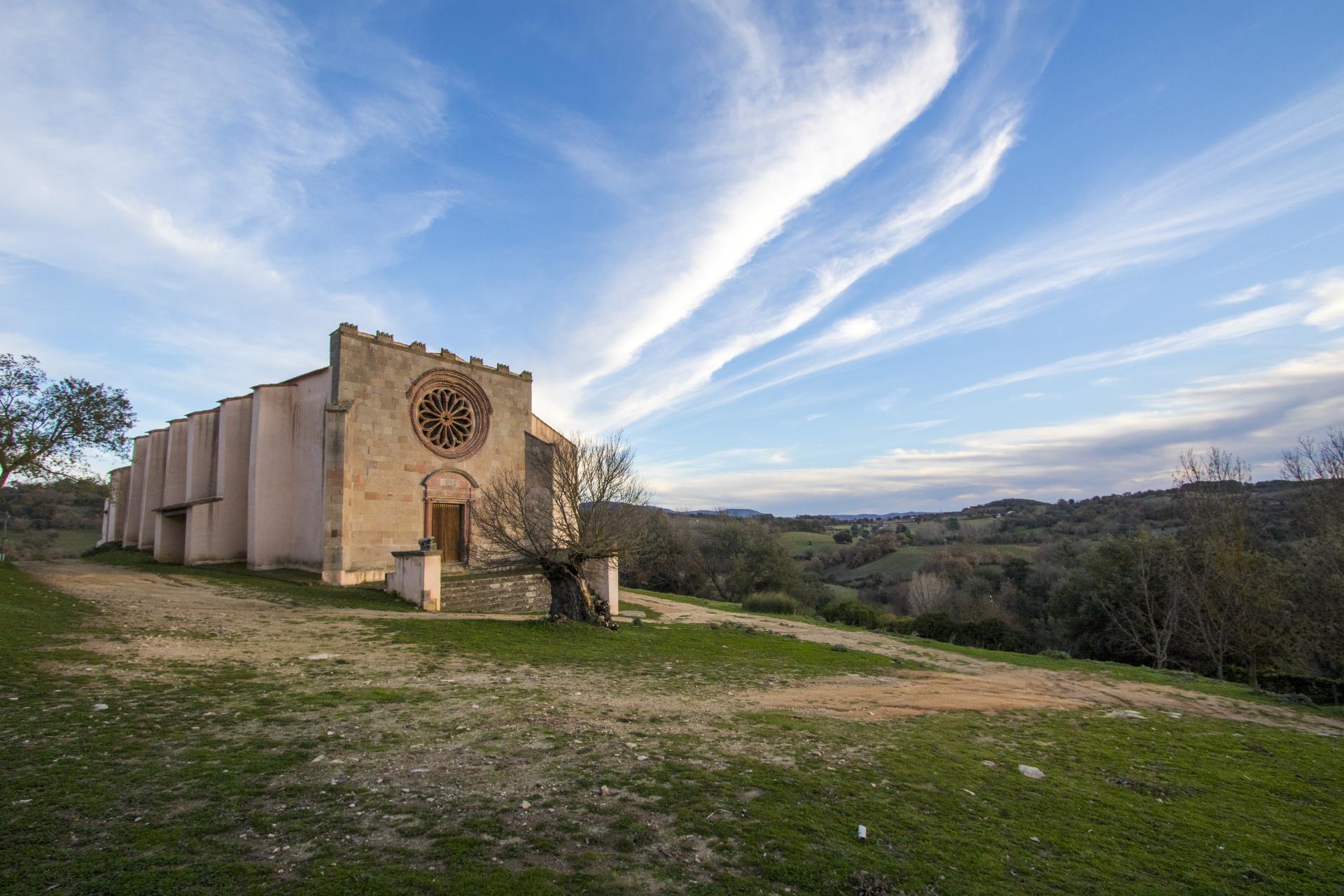
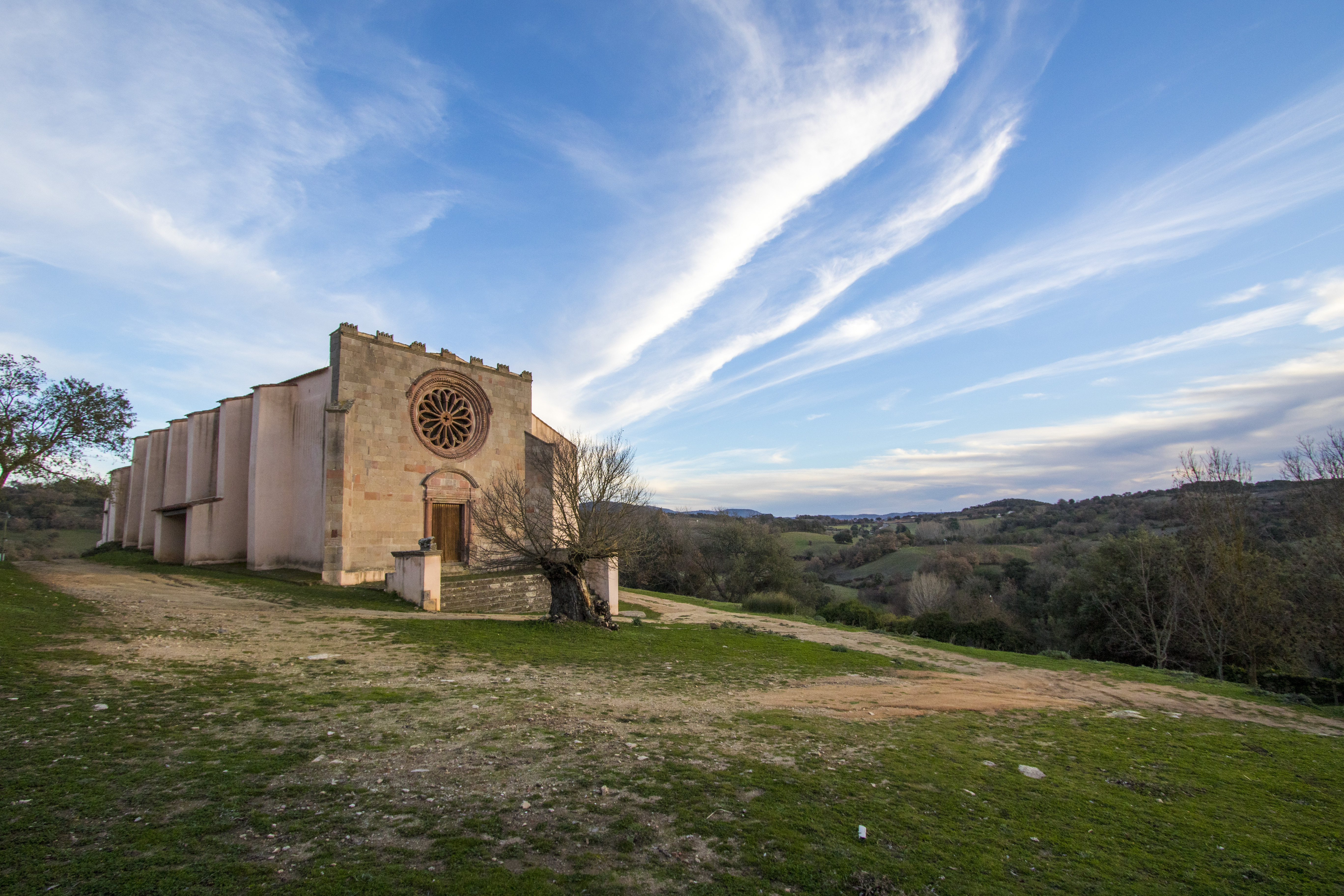
The rural church dedicated to Saint Mauro stands on a rocky ledge, at the top of a gentle slope in the south-western part of the municipality of Sorgono, at about 478 metres above sea level.
The complex did not originate from a single design phase but underwent overlapping additions and alterations in different periods. The current structure can be dated between the end of the 16th century and the first half of the 17th century A.D. (1574) and was built over a 12th-century church which, in all likelihood, had itself incorporated an earlier structure of which no trace remains. The sanctuary of Saint Maurus turns out to be an imposing construction compared to other churches in rural Sardinia; a possible explanation that could justify the construction of such an important monumental work might be sought in some sentence of the court of the Spanish Inquisition against a nobleman of the region or against the entire population of the Mandrolisai, in order to atone for a particularly serious guilt.
Saint Maurus the Abbot was a monk of the Benedictine order, among the principal disciples of Saint Benedict of Nursia. The veneration of Saint Maurus was spread by the Cluniacs; in classical iconography he is often represented in a very austere manner, with the abbot’s crosier and a crutch, since he is considered the patron saint of the lame and those suffering from gout. Miraculous deeds are attributed to him: walking on water, seeing and casting out demons; in tradition he is invoked for healing from illnesses and in any situation of difficulty or danger.
The sanctuary dedicated to Saint Maurus is opened to worshippers three times a year:
- In mid-January to invoke Santu Maru de is dolos;
- On the Tuesday after Easter, Santu Maru de flores;
- At the end of May for the ancient celebration of Santu Maru erriccu.
On this last occasion the main feast dedicated to the saint is celebrated; in ancient times the feast lasted six days and, before the beginning of Santu Maru erriccu, for nine days, the women of the area would perform the novena, walking on foot to the rural church and there, praying, circling the church on their knees. On the day of the feast the statue of the saint was carried in procession around the church, accompanied by the faithful with prayer chants and goccios (metrical poems set to music dedicated to the Saint).
The façade of the church faces west, has a square composition, and is built of grey trachyte blocks; its upper terminating edge is crenellated, and it is interrupted at the centre by an imposing Gothic rose window measuring 4.40 m in diameter, made up of 14 coupled small columns radiating from a central element pierced with a cross-shaped motif, all enclosed within a moulded frame, surmounted by a hood mould supported on either side by two angels. Below the rose window there is a portal of late-Mannerist inspiration which, in the overall context of the façade, creates a syncretism typical of the more archaic fronts of Gothic-Catalan structures in central-southern Sardinia. On the sides of the façade are two buttresses set diagonally which have no structural function but serve as an aesthetic device to embellish and frame the front of the sanctuary. The front is preceded by a stairway flanked by masonry wings, at the top of which stand two leonine statues holding the shield of Aragon.
The plan layout is very simple; the church consists of a rectangular hall 8.63 m wide and 20.18 m long, with, at the eastern end, an attached presbytery, also rectangular, 7.35 m wide and 9.72 m long, for a total internal length of 30.60 m. The interior space of the church is highly distinctive, making it a unicum in the island context; the Catalan influence is evident, expressed by the single-nave hall, divided into six bays marked by five pointed transverse arches that run along the pyramidal vault, descending to rest on smooth pilaster strips in grey trachyte.
The vault of the nave does not have a horizontal axis but is inclined by about 50 cm over 20 m from the presbytery towards the façade, with the intention of achieving an optical correction of perspective. In each bay there open trapezoidal-plan niches in Renaissance style; a round arch, surmounted by a pediment with an oculus at its centre, separates the hall from the presbytery. The presbytery, raised about 50 cm above the floor level of the hall, is covered by a barrel vault with a semicircular profile, also inclined by about 10 cm. In the presbyterial area stands the Baroque marble altar dating from the 18th century.
The floor is of grey trachyte, composed partly of hexagonal tiles and partly of octagonal elements with square connectors. From the surveys it was discovered that the Spanish foot (27.86 cm in length) was used as the constructional unit of measure, revealing an incredible metrical and proportional correspondence between the various spaces.